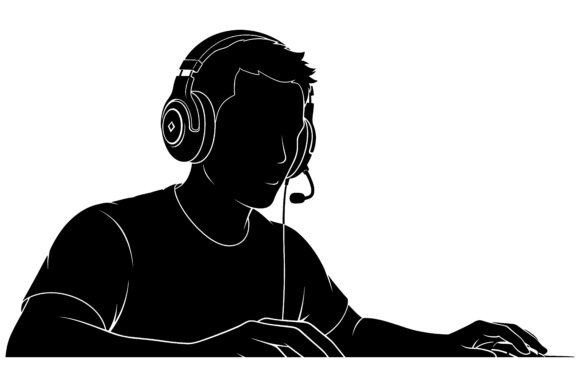
Gamer Boy Playing Video Games Silhouette
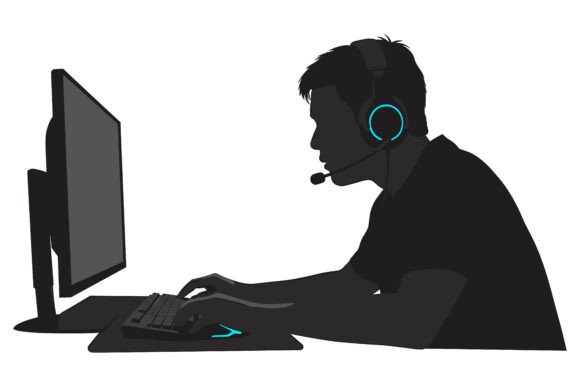
Visual communication often relies on instantly recognizable symbols. A gamer boy playing video games silhouette delivers that clarity without needing a detailed illustration. The shape of a young male seated before a monitor, one hand on a keyboard, the other on a mouse, a headset curved over the ears—this single graphic can define mood, topic, or brand identity. When you receive both a 1 EPS file and a 1 JPG file, you hold a versatile asset ready for everything from presentation slides to full-scale print. It fits into design workflows not as a decoration but as a functional tool that solves problems of speed, consistency, and concept delivery.
What Defines a Gamer Boy Playing Video Games Silhouette?
The silhouette strips away detail to leave only posture and equipment. A gamer boy profile, often viewed from the side, captures the intense concentration of an esports competitor or a hobbyist deep in late-night gameplay. The monitor glow, keyboard tilt, mouse grip, and headset microphone combine into a universal gaming signature. Because the image is isolated from its background, you can drop it onto anything—dark interfaces, bright banners, t-shirt designs—without worrying about background clashes. The EPS file gives you vector-based scalability, meaning it remains perfectly crisp on a billboard or a business card. The JPG file serves quick previews and immediate placement in raster-based projects.
This asset centers on a modern digital lifestyle: a person, boy, teenager, or young adult, fully engaged with virtual worlds. The black figure against white (or transparent) background emphasizes form over identification. It’s neither a specific celebrity nor a generic stick figure—it’s a silhouette that many in the gaming community will see and immediately connect with. That recognition speeds up comprehension in any composition.
Where This Graphic Asset Fits Into Digital Projects
Understanding where the gamer boy playing video games silhouette fits prevents it from becoming an afterthought. Think of your project as a layered process: concept, layout, asset selection, refinement, and delivery. This silhouette enters best during the asset selection phase, after you’ve pinned down the core message but before you finalize layouts. It serves a functional role—labeling a gaming category, anchoring a hero image, or balancing a layout with a strong vertical or horizontal shape.
For streamers setting up overlay graphics, the silhouette marks a “starting soon” screen or a “brb” card without pulling attention away from the streaming interface. For marketers building landing pages, it becomes a hero visual that instantly defines audience and activity. For bloggers writing about esports strategies, it illustrates a post header without the need for expensive photography or model releases. The practicality lies in its flexibility: change its color to fit your brand palette, rotate it for a subtle directional cue, or duplicate and scale it for a composite scene.
Integrating the Silhouette into Visual Workflows
The jump from downloading a file to seeing it in a polished design requires a smooth integration path. Start by opening the EPS file in a vector editor like Adobe Illustrator, CorelDRAW, or free alternatives such as Inkscape or Gravit Designer. The EPS format retains all vector data, so you can ungroup objects if the original creator separated the monitor from the person from the chair. This granular control lets you recolor individual elements, remove the keyboard if you prefer a controller silhouette, or combine the gamer with other silhouette assets like a gaming chair or a desk.
For quick mockups, drag the JPG file directly into presentation software, Canva, or Figma. The JPG’s white background becomes a non-issue if you set it to multiply blend mode or use a simple remove background tool—many modern platforms include one-click background removal. The silhouette’s high contrast makes automatic background removal nearly flawless, giving you a transparent version in seconds even without accessing the vector source. This dual-file approach (EPS for precision, JPG for speed) creates a flexible pipeline that doesn’t force you to jump between heavy software for every small task.
Control the silhouette’s integration by assigning it to a specific layer in your design file. Because it occupies a defined space—a seated figure at a desk—it often works best as a foreground or midground element. Pair it with semi-transparent UI elements, stats overlays, or leaderboard graphics to build a cohesive e-sports dashboard. Or use it as a subtle background motif, scaled down and faded to 5% opacity over navigational panels. The silhouette’s simplicity prevents it from competing with text when handled with low opacity.
Practical Uses Across Media and Platforms
The asset list keywords point to scenarios that demand clarity. A gamer boy playing video games silhouette supports a wide range of outputs.
- Streaming and content creation: Design alerts, webcam frames, offline screens. A silhouette signals the gaming activity without showing the streamer’s actual face, useful when privacy or style demands abstraction.
- Educational and training materials: An illustration for a course on game design, coding, or esports management. The silhouette reinforces the subject without leaning too heavily on a specific game’s art style, avoiding copyright pitfalls.
- Print collateral: Flyers for gaming tournaments, posters for LAN parties, club t-shirts. Because the EPS file scales infinitely, you can output sharp graphics for any physical format.
- Web and app UI: Avatar placeholders, loading states, error pages. The silhouette carries a dynamic activity; a gamer at a keyboard suggests connection and engagement, turning a dead end into a thematic moment.
- Social media graphics: Quote cards from game developers, “tip of the day” images for coaching accounts, YouTube channel art. The silhouette’s profile view leaves ample horizontal or vertical space for text.
- Brand identity: A gaming peripheral company might simplify the silhouette into a logo mark. Remove the monitor for a streamlined icon, keep the headset for recognition.
Each of these uses leverages the silhouette not as a literal photo but as an interpretation. The absence of facial features lowers bias and broadens appeal. It could represent any teenager, any young male, any person seated at that virtual cyber threshold. This universality increases the asset’s shelf life across diverse campaigns.
Design Considerations for Maximum Impact
Even a simple silhouette benefits from deliberate placement. Consider the surrounding negative space. The shape includes the monitor’s horizontal block and the gamer’s vertical profile, forming an L-shaped composition. Use that geometry to guide the viewer’s eye toward a headline or call-to-action button. If the figure faces right, place your most important information on the right side to align with the implied direction of his attention—he’s looking at the screen, after all.
Color choice transforms mood. A neon cyan silhouette on a dark navy background reads as cyberpunk, ideal for late-night gaming streams. A muted gray silhouette on a white background suits a corporate training deck about gamification. A gradient overlay on the silhouette (applied easily in vector software by converting strokes to compound paths) can introduce multiple brand colors, bridging a minimal graphic with vivid branding requirements. Always preserve a master copy of the original EPS file untouched so you can revert to the clean source.
Contrast with typography matters. The silhouette includes fine details—the headset arc, the microphone boom, the curved fingers over the mouse. When you place bold sans-serif headlines near these details, ensure adequate spacing. A silhouette works best when it’s either the dominant element or a deliberate supporting player; avoid mid-ground obscurity that leaves it mistaken for noise.
The JPG file, being raster, introduces subtle aliasing at extreme magnifications. For print runs, always use the EPS version. For web use, export from the EPS at the exact pixel dimensions your layout requires. This avoids browser scaling artifacts and keeps file sizes minimal. If you only have access to the JPG and need a larger version, consider tracing it into vector using automated trace tools in design software—most produce acceptable results due to the silhouette’s high internal contrast.
Long-Term Value of a Well-Crafted Silhouette
Unlike trend-driven photography or 3D renders that date quickly, a monochromatic silhouette endures. The gamer boy representing a person in front of a screen will remain relevant as long as screen-based digital entertainment and work exist. That longevity makes it a cost-effective asset. You purchase or download it once and apply it across years of projects—website redesigns, event series, rebranded YouTube channels—without the style appearing outdated.
Organize the files in a well-structured resource library. Tag them with keywords like “silhouette”, “gamer”, “esports”, “profile”, “young male”, “digital lifestyle” so they appear instantly in your asset management system. If you use a cloud storage platform with team sharing, store both the EPS and JPG versions with a clear naming convention: “gamer-boy-playing-video-games-silhouette-vector.eps” and “gamer-boy-playing-video-games-silhouette-raster.jpg”. This saves colleagues hours of searching and prevents duplicate purchases.
When working with external contractors—illustrators, video editors, motion designers—provide the EPS file directly. They can manipulate the vector points to create animated fades, morphs, or outline transitions. A motion designer might convert the silhouette into an After Effects shape layer, then stroke-reverse it to reveal the gamer and monitor from thin air. This reused asset feeds into higher-budget productions without additional cost, stretching its value further.
Quality control always starts with the source. Confirm the EPS was built as clean vectors, not a raster image embedded inside a vector container. Open it and inspect the layers: well-grouped shapes with minimal anchor points ensure smooth scaling and recoloring. If the JPG shows any compression artifacts, the EPS should bypass them entirely. A reliable silhouette package will have crisp edges and no stray elements floating outside the main figure. Checking these details upon acquisition prevents integration frustration later.
Consider the silhouette’s interaction with surrounding assets. In a composite graphic, you might pair the gamer boy silhouette with a blurred, colorful screenshot of an actual game. The contrast between abstract figure and concrete background reinforces the activity without losing the human element. Or invert the approach: fill the silhouette with a gameplay scene using a clipping mask, so the gamer contains the virtual action. This technique appears frequently on thumbnails and posters, turning the silhouette into a window rather than a solid shape.
For those working with esports teams or gaming communities, the silhouette can become a consistent identifier. Apply the team’s colors, add the player’s nickname in a custom font dug into the negative space of the monitor, and suddenly a generic asset becomes personalized. The EPS file’s editability makes this quick—select the monitor’s vector shape, subtract the text, and you have a unique locker tag or jersey print ready.
Ultimately, a gamer boy playing video games silhouette is more than a stock graphic. It’s a structural element that anchors visual narratives, speeds up decision-making, and maintains brand consistency across platforms. The combination of a scalable EPS file and an instantly usable JPG file removes technical obstacles, letting you focus on composition and message. Understand its role in your workflow—whether as a placeholder, hero element, or background motif—and you’ll embed it into designs with purpose, not merely because it matches the keyword list.