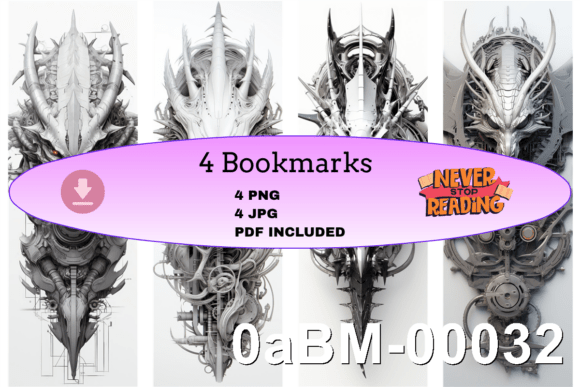
Steampunk Mechanical Dragons: Where Myth Meets Machinery
There is a particular kind of creative asset that does more than fill a folder on your hard drive. It shifts the direction of a project, suggests new possibilities, and quietly raises the visual standard of everything it touches. The Steampunk Mechanical Dragons collection belongs in that category. It takes two rich imaginative traditions — ancient dragon mythology and industrial-era mechanical design — and fuses them into something that feels both familiar and unexpectedly fresh.
What you are looking at is a set of four high-resolution dragon portraits, each built around a different mechanical interpretation of the creature. Gears replace scales. Armor plating defines the contours of the skull. Cables and conduits trace paths that organic veins once occupied. The eyes glow, hinting at some internal power source that sits halfway between magic and combustion. The overall effect is precise, deliberate, and surprisingly versatile across a range of creative disciplines.
For anyone working in fantasy art, game concept design, digital scrapbooking, or steampunk-themed visual projects, this collection addresses a specific and recurring problem: finding assets that balance mechanical complexity with mythological presence without tipping too far into either cartoon exaggeration or clinical technical illustration. The execution here lands in a productive middle ground.
What Defines the Steampunk Mechanical Dragon Aesthetic
Steampunk as a design language has been around long enough to develop its own clichés. Brass gears glued to anything that stands still. Goggles for no reason. Excessive rivets as a substitute for actual mechanical thinking. What separates thoughtful steampunk design from decoration is internal logic — the sense that the machinery could function, even if it defies known physics.
The dragon illustrations in this collection lean into that internal logic. Each head is not merely a reptilian shape with gears pasted on top. The mechanical elements are structural. Horns emerge from machined mounts. Jaw mechanisms suggest articulation points where organic tendons would attach. The gear-driven anatomy visible beneath transparent or open plating creates a layered depth that rewards closer inspection. This is not surface-level texture work. It is compositionally integrated design.
The color palette across the four portraits maintains steampunk's characteristic warmth — aged brass, darkened steel, oxidized copper tones — but introduces enough variation that the set does not feel like one idea repeated four times. Each dragon has a distinct personality, a different arrangement of mechanical elements, and a unique silhouette. That variation matters when you are building a world or a visual narrative that needs multiple creatures to feel related but not identical.
Material Quality and Presentation Standards
Resolution and output quality make or break illustrated assets for professional use. A design that looks striking at thumbnail size can fall apart when scaled for print or integrated into a high-resolution composition. The Steampunk Mechanical Dragons set is delivered at a resolution that holds up under enlargement, which immediately expands its practical range.
Each image sits on a clean, neutral background. This is a deliberate and useful choice. Assets with busy or colored backgrounds require extraction work before they can be composited into new environments. A neutral presentation means the dragons can drop directly into dark fantasy scenes, metallic world-building layouts, or printed materials without fighting the surrounding design. The isolation also makes them suitable for merchandise mockups, where the dragon needs to be the undisputed focal point.
Edge detail on the mechanical components is crisp without being artificially sharpened. There is a natural falloff in focus where depth of field would logically occur, which helps the illustrations read as dimensional objects rather than flat vectors. For concept artists and designers who composite multiple elements into a single scene, this baked-in depth perception reduces the post-processing work required to make the asset feel grounded in a space.
Practical Applications Across Creative Workflows
Where these dragons fit into real projects depends partly on the creator's field and partly on how flexibly they think about asset usage. The most obvious applications draw on the fantasy and steampunk themes directly.
Gaming and Concept Art
Game designers and concept artists working on steampunk, dieselpunk, or dark fantasy titles will find these portraits immediately usable as reference material, placeholder assets in pitch decks, or direct elements in key art. The mechanical detailing provides a visual vocabulary that can be extended into full creature designs. A single well-executed head study often informs the mechanical logic of an entire creature rig, saving hours of exploratory sketching.
Print and Merchandise
The high resolution and neutral backgrounds make these illustrations suitable for printed products. Bookmarks and posters are the straightforward use case, but the designs also translate well to journal covers, notebook inserts, and decorative prints for themed spaces. The steampunk aesthetic has a dedicated audience that consistently purchases art prints, and dragon imagery has never stopped being commercially viable. Combining the two creates a product that speaks to overlapping buyer interests.
Digital Crafting and Scrapbooking
Digital scrapbookers and journaling creators often need focal-point imagery with a clear thematic identity. These dragons fill that role while offering enough detail to justify prominent placement on a page. Because the backgrounds are neutral, the illustrations integrate with paper textures, layered ephemera, and typography without requiring masking skills on the user's end.
World-Building and Visual Development
For writers, tabletop game masters, and independent world-builders, visual assets serve a function beyond decoration. They anchor the imagination. Having a concrete, high-quality image of a mechanical dragon makes the creature feel real in a way that prose descriptions alone cannot achieve. These portraits can function as character reference sheets for creatures in a campaign setting or novel, providing consistent visual reference across a long-term creative project.
Strengths That Set This Collection Apart
Several attributes distinguish the Steampunk Mechanical Dragons set from comparable fantasy illustration bundles. The first is thematic coherence without repetition. Many asset packs offer quantity over considered variation. This set contains only four portraits, but each one justifies its inclusion through distinct design decisions. One dragon might emphasize angular armor plating and weaponized horns. Another might lean into exposed gear trains and a more serpentine profile. The variety is meaningful rather than cosmetic.
The second strength is aesthetic restraint. There is a temptation in steampunk illustration to add detail until the image becomes noisy. These portraits exercise enough restraint to preserve readability. The mechanical elements are intricate, but they serve the overall silhouette and expression of the dragon rather than overwhelming it. You can see the dragon first, then discover the mechanical details. That hierarchy of perception is difficult to achieve and easy to overlook.
The third strength is cross-platform versatility. Because the dragons are presented as isolated portraits on neutral backgrounds, they work across light and dark interfaces, printed and digital formats, and a range of compositional styles. An asset that locks you into a specific background color or mood has a narrower range. These avoid that limitation by design.
Evaluating Limitations and Practical Considerations
No creative asset serves every purpose, and honest evaluation requires acknowledging boundaries. These are portrait-focused illustrations. They do not include full-body designs, which means someone who needs a complete creature reference from snout to tail tip will need to supplement or extrapolate. For head-focused applications — key art, bookmarks, iconography, bust compositions — the portraits excel. For full creature sheets or animation reference, they represent a starting point rather than a complete solution.
The steampunk aesthetic, while broadly popular, is also specific. Projects set in high fantasy, futuristic sci-fi, or contemporary settings may find the mechanical style incongruous. The dragons fit seamlessly into steampunk, dieselpunk, gaslamp fantasy, and certain cyberpunk-adjacent aesthetics. Outside those genres, integration requires more effort and creative justification.
The set includes four distinct designs, which is generous for focused portrait work but limited for creators who need an extensive bestiary. Consider this a premium, curated collection rather than a volume pack. The value lies in the quality and design depth of each piece rather than in quantity.
Who Gains the Most from These Assets
The profile of the ideal user for the Steampunk Mechanical Dragons collection is fairly clear. Independent game developers working on steampunk or dark fantasy titles will find immediate use for key art, promotional materials, and in-game lore illustrations. Digital artists who create composite fantasy scenes can layer these dragons into environments without extensive extraction work. Print-on-demand sellers focusing on the fantasy and steampunk market have ready-made designs for merchandise testing.
Educators teaching concept art or digital illustration can use the portraits as examples of mechanical design integration, showing students how organic forms and industrial elements can combine without one dominating the other. Writers and tabletop creators gain visual anchors for creature descriptions and campaign materials. The common thread is a need for high-quality, thematically consistent fantasy imagery that does not require the user to be an illustrator themselves.
Freelance designers who periodically take on fantasy or gaming-adjacent client work will also benefit from having these assets available. Client projects with tight turnaround times often reward having a library of usable, high-resolution elements that can be adapted quickly rather than created from scratch. The neutral backgrounds make compositing fast, and the mechanical detailing holds up under client scrutiny.
How the Collection Performs in Extended Use
One test of an illustration set's value is how it behaves across multiple projects over time. An asset that feels impressive on first download but never leaves the folder is not actually useful. The Steampunk Mechanical Dragons set rewards revisiting. Because each portrait contains layered mechanical information, different details emerge depending on the scale and context of use. A dragon that serves as a bookmark focal point in one project can be cropped tightly on the eye and gear assembly for a completely different application in another.
The consistency of lighting across the four portraits also matters for projects that use multiple dragons together. If one illustration were lit from above and another from below, compositing them into a shared scene would require adjustment. The shared lighting logic across the set reduces that friction, making multi-dragon compositions more straightforward.
File format and delivery considerations vary by platform, but the clean presentation means these assets import predictably into Photoshop, Procreate, Affinity, Canva, and other common design tools. There is no unexpected transparency behavior or embedded background to remove. What you see in the preview is what arrives in the file.
Making an Informed Decision
Creative asset purchases sit at an odd intersection of practical tool acquisition and artistic inspiration. The best assets function as both — solving a concrete production problem while also sparking ideas for projects that did not exist before the download. The Steampunk Mechanical Dragons collection operates effectively in both modes.
If your work or creative practice intersects with steampunk, dark fantasy, mechanical creature design, or mythological reimagining, these portraits fill a specific and high-demand niche. The resolution, isolation, and design quality make them usable across print and digital formats with minimal friction. The thematic coherence across the set supports world-building and narrative consistency. The limitations — portrait format only, specific aesthetic range — are reasonable trade-offs for the depth and polish delivered within those bounds.
For the creator who needs a metallic dragon forged in gears and powered by imagination, this collection delivers precisely what its premise promises. It does not try to be everything. It focuses on doing one thing — mechanized dragon portraiture — with enough skill and variation to earn its place in a professional asset library.